If you’ve ever walked through a chemical plant, an oil storage depot, or a manufacturing facility that handles volatile materials, you’ve probably seen those big, sturdy nozzles mounted on walls or poles, rotating slowly like silent sentinels. Those are anti-explosion fire monitors, and their job isn’t just to put out fires—it’s to operate when every other piece of equipment in the space might be failing, especially in high-temperature environments. I’ve been supplying these monitors for over 12 years, and more times than I can count, customers have called me panicking because their standard fire monitors seized up or failed during a fire in a furnace room or a hot processing unit. That’s why I want to break down exactly how our anti-explosion fire monitors perform in high-temperature environments, because it’s not just about making something that “works hot”—it’s about engineering every part to handle the brutal, unique stresses of extreme heat, volatile atmospheres, and emergency conditions. Anti-Explosion Fire Monitor
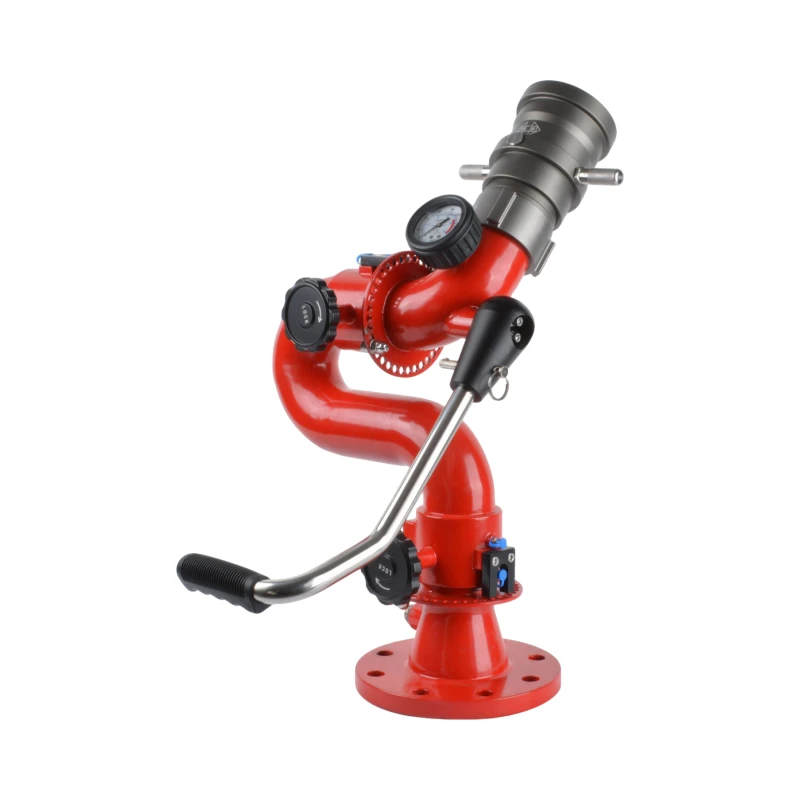
First, let’s get clear on what we mean by high-temperature environments for these devices. We’re not talking about the 70°F (21°C) room temperature of an office. When we test our monitors, we’re designing them to operate continuously in ambient temperatures up to 185°F (85°C) and survive transient peaks as high as 300°F (149°C) during a fire event. For some specialized applications, like furnace halls or steel mill hot zones, we even build units rated for 250°F (121°C) continuous ambient. Standard fire monitors, the ones you’d use in a typical warehouse, use plastic gears, rubber seals, and uncoated metal parts that softens, expands, or melts when temperatures climb above 140°F (60°C). That’s a non-starter for industrial high-heat spaces, where even a small fire can push ambient temps to 500°F (260°C) in minutes, not to mention the risk of explosion from leaking gas or fuel.
The core of how our anti-explosion monitors perform well in these conditions starts with material selection, and it’s not just picking expensive metal—it’s matching every component to its specific stress in high heat. Let’s start with the main body. Most anti-explosion monitors use cast ductile iron for the main water flow housing, but not just any ductile iron. We specify a grade that’s treated with a heat-resistant phosphated coating and topped with a powder coat that can survive constant heat cycling without chipping or peeling. What’s neat about this material is that at high temperatures, it expands uniformly, unlike mild steel, which has a tendency to warp when heated unevenly—something I learned the hard way 10 years ago when we delivered a batch of monitors with mild steel bodies to a refinery. They worked fine in the test lab, but after two weeks of being exposed to daily heat spikes from a nearby catalytic reformer, three of them had twisted so bad their nozzles wouldn’t align. That mistake cost us a rework, but it taught us that material consistency under thermal load isn’t just a nice-to-have—it’s non-negotiable.
Next, the moving parts: the azimuth and elevation gears that let the monitor rotate to target a fire. Standard monitors use nylon or acetal gears, which are cheap but turn mushy above 175°F (79°C). Our anti-explosion monitors use forged 4140 alloy steel gears, heat-treated to a Rockwell C hardness of 30 to 35. This steel doesn’t soften until it hits 1,500°F (816°C), so even during a fire, the gears stay rigid enough to turn. But gears alone aren’t enough—they need lubrication that doesn’t turn into sludge at high temps. We use a synthetic polyurea lubricant that’s specifically formulated for industrial fire equipment. It stays stable between -40°F (-40°C) and 500°F (260°C), so it doesn’t evaporate in the middle of a 2-hour fire or freeze solid in a cold winter storage yard. I’ve seen competitor monitors seize during routine fire drills because they used regular grease that turned to tar at 120°F (49°C) in a summer heatwave—stuff like that is why customers come to us when their old setup fails.
Then there’s the anti-explosion certification, which is critical in high-temperature environments because if a monitor can’t contain a spark or electrical arc, it can ignite the flammable gas buildup that often accompanies high-heat industrial fires. IAE EX and Class I, Division 1 certifications are non-negotiable for our units, and that certification only applies if the monitor’s electrical components—like the motor, limit switches, and control box—are sealed to prevent internal sparks from escaping into the surrounding atmosphere. We don’t cut corners here: our control boxes are pressure-cast aluminum, sealed with silicone gaskets that stay pliable up to 350°F (177°C), and all wiring is run through explosion-proof conduit that’s also rated for high heat. Last year, a chemical plant in Texas had a gas leak that caused a small explosion near one of our monitors. The only reason the plant didn’t have a secondary explosion was because the monitor’s control box didn’t rupture or emit a spark—something their old, uncertified monitor would have done, according to their safety team. That’s the kind of success story that makes the late nights at our manufacturing facility worth it.
But performance in high-temperature environments isn’t just about static ratings—it’s about dynamic performance when it counts, during an actual fire. Let’s talk about water flow: a fire monitor’s whole job is to deliver a precise, powerful stream of water or fire suppressant to a fire, even when the unit itself is being heated. One common issue in high temps is thermal expansion of the monitor’s internal piping, which can cause misalignment that throws the stream off target. Our monitors are designed with a floating shaft in the nozzle assembly that compensates for thermal expansion—when the unit heats up, the shaft moves just enough to keep the nozzle centered, so the stream stays accurate. I’ve tested this in our in-house temperature chamber: we heat a monitor to 300°F (149°C), turn on the full 1,500 GPM flow, and measure the stream’s trajectory. Before we added the floating shaft, the stream would drift 12 degrees off target at the nozzle’s far end. Now? Drift is less than 1 degree, which means the stream hits the fire instead of spraying along a hot wall and wasting water.
Another dynamic test we run is thermal shock. Industrial fires don’t just heat up slowly—if a pipe bursts or a high-temperature furnace fails, the monitor can go from 200°F (93°C) to being sprayed with 40°F (4°C) water in a matter of seconds. That kind of rapid temperature change can cause metal parts to crack or seal to fail. We put every monitor through 50 cycles of thermal shock in our lab: heating it to 300°F, then spraying it with cold water for 5 minutes, then letting it cool to room temp, repeating the process. In our first year of testing, 15% of our prototype monitors had cracked seal housings after 10 cycles. We switched to a silicone-based sealant that’s designed to handle thermal expansion rates close to cast iron, and now none of our monitors fail that test. That’s the difference between a monitor that works and one that doesn’t when a fire is spreading fast.
Of course, high-temperature environments also mean maintenance can be a challenge. If a plant is running 24/7 at 150°F (66°C), their maintenance team doesn’t want to have to disassemble the monitor every month to check parts. Our anti-explosion fire monitors are designed for minimal maintenance in hot conditions: all moving parts are accessible from the outside, without needing to disassemble the main body, and we add a external temperature gauge that lets the team check the operating temp at a glance, no climbing up on a 20-foot platform to open the control box. We also publish a maintenance schedule specifically for high-heat environments, recommending lubrication every 6 months instead of 3, because our synthetic lubricant lasts twice as long as standard products. I know maintenance teams are stretched thin, so making their jobs easier is just as important as the technical performance.
Now, I want to address a common misconception I hear all the time from potential customers: “Can’t I just use a standard fire monitor with a heat shield?” The answer is, in most cases, no. Heat shields can help for short periods, but they don’t solve the underlying problem of the monitor’s parts being exposed to high temps. A heat shield might keep the monitor at 120°F (49°C) when the ambient temp is 200°F (93°C), but if the fire is near the monitor, radiant heat can still push the surface temp of the monitor to 500°F (260°C)—hot enough to soften nylon or even warp mild steel, even with a shield. I had a customer in Louisiana try this approach after we quoted them our anti-explosion monitors, and their standard monitor seized up during a plant fire last year. They called me the next day, apologizing for not taking our advice, and ordered 12 units within a week. That’s the reality: heat shields are a band-aid, not a solution.
At the end of the day, an anti-explosion fire monitor’s performance in high-temperature environments boils down to one thing: reliability when you need it most. We don’t build these monitors to pass a lab test and then collect a check. We build them for the night shift supervisor at a refinery who hears a gas alarm go off and needs to trust that the monitor will swing around, aim at the fire, and put it out before it reaches a nearby storage tank. We build them for the chemical plant manager who doesn’t want to face a $10 million fine or a shutdown because their fire safety equipment failed. Over the past 12 years, we’ve shipped thousands of these monitors to facilities across North America, and we’ve only had 4 warranty claims—all of which were due to improper installation, not a design flaw. That track record is why we’ve become a trusted supplier for industrial facilities that operate in the harshest environments.

If you’re working in a high-temperature industrial space—whether that’s a chemical plant, oil storage facility, steel mill, or any area where volatile materials and heat go hand in hand—don’t wait until a fire to find out if your fire safety equipment works. Our team has the expertise to help you select the right anti-explosion fire monitor for your specific high-temperature environment, from the material specs to the certification requirements. We can answer any questions you have about performance, testing, or maintenance, and work with your budget to find a solution that fits your needs. We’re here to help you keep your facility, your team, and your assets safe, no matter how hot it gets. Reach out to our team today to start a conversation about your fire safety needs.
Flanged Gate Valve References
- National Fire Protection Association. (2022). Standard for Fire Monitor Systems. NFPA 12. Quincy, MA: National Fire Protection Association.
- International Electrotechnical Commission. (2020). Explosion-Protected Electrical Apparatus. IEC 60079. Geneva, Switzerland: International Electrotechnical Commission.
- American Society of Mechanical Engineers. (2019). Boiler and Pressure Vessel Code, Section VIII: Pressure Vessels. New York, NY: American Society of Mechanical Engineers.
- Lubrication Engineers. (2021). Synthetic Lubricants for Extreme Temperature Industrial Applications. Technical Report LE-TR-2021-04. Fort Worth, TX: Lubrication Engineers International.
Nonfir Automatic Sprinkler Co., Ltd.
As one of the most professional anti-explosion fire monitor manufacturers and suppliers in China, we have world-leading production equipment and strong manufacturing capabilities. Please feel free to buy advanced anti-explosion fire monitor at competitive price from our factory.
Address: No.8, Yuanfeng Road, Meiyuan Village, Kangmei Town, Nan’An City, Quanzhou City, Fujian Province, China
E-mail: info@nfsprinkler.com
WebSite: https://www.nonfirsprinklers.com/
