When I was walking through our stamping die shop last week, I noticed our new apprentice staring at a stack of mild steel blanks like they held some secret. He’d just watched us run a series of jobs for a kitchen appliance manufacturer, and later he asked me a question I get all the time: “How do you know which die works for which material?” It’s not a question you learn in a textbook—it’s something you pick up over 12 years of building dies, troubleshooting runs, and seeing what happens when you pair the wrong tool with the wrong stock. Today, I want to break that down for anyone who’s ever hesitated when choosing a stamping die, especially if you’re sourcing dies and wondering where to start. Stamping Die

Let’s start with the most common material we work with: carbon steel. This is the workhorse of stamping—used in car bodies, appliance panels, structural parts for everything from tractors to playground equipment. When I first started in this industry, I thought all carbon steel was the same. I learned that lesson fast when we built a deep-draw die for a customer making water heater tanks. We used a standard high-carbon die steel, ran the first trial, and the cups came out with so many surface scratches the customer rejected them. Turns out, that batch of carbon steel they’d chosen was a soft draw-grade, but we’d built the die with too sharp a corner radius—so the material was tearing as it stretched over the die’s edge.
For thin-gauge carbon steel (under 3mm), you want a die with polished cavity surfaces and rounded radiuses. The goal here is to reduce friction, so the material flows smoothly. We often use dies coated with titanium nitride (TiN) for these jobs—the coating cuts friction by almost 40%, and it resists galling, that sticky buildup of metal that ruins both material and die. For thicker carbon steel (over 3mm), like structural brackets, you need a die with a harder core. We usually go with D2 tool steel for these, because it holds up to the high impact and pressure of punching or bending thick stock. Last quarter, we did a run of 10,000 forklift support brackets from 8mm carbon steel. If we’d used a softer die, the edges would have chipped after 2,000 runs. The D2 die we built? We still use it for follow-up jobs six months later.
Next up is stainless steel, which is a whole different beast. Stainless is strong, corrosion-resistant, but it work-hardens faster than any material we run. That’s one of the first rules I drill into our team: never run a stainless job with a die designed for carbon steel. Last year, a customer brought us a die they’d bought elsewhere for making automotive exhaust hangers. They’d run 500 parts, and the die was already failing. The problem? The original die was made for mild steel, so when the stainless work-hardened during stamping, the die’s edges couldn’t hold up. Stainless also has a tendency to gall—when tiny bits of material stick to the die surface, leaving blemishes on the part.
For stainless steel, we build dies with a thicker cross-section and larger clearance between the punch and die. Standard clearance for carbon steel is about 10% of the material thickness, but for stainless, we increase that to 15-20%. That extra space gives the material room to flow without binding, which reduces work-hardening. We also use dies with a carbide insert for the punching edge. Carbide is harder than tool steel, so it resists the friction of stainless. I remember a customer who was stamping medical device parts from 1.5mm 304 stainless. They were getting 10,000 parts per die before, but since we switched them to carbide inserts, they’re now hitting 50,000 parts with perfect finish. That kind of number makes a difference when you’re doing high-volume medical production—downtime for die changes costs more than the die itself.
Aluminum is another material we work with a lot, especially for aerospace and consumer electronics. Aluminum is light, soft, and has a high malleability, but it’s also prone to tearing if the die isn’t set up right. The biggest mistake we see with aluminum stamping is using too much pressure. Because it’s softer, the die doesn’t need as much force as steel. If you crank up the press to match a carbon steel run, you’ll get wrinkling in deep draw parts and uneven edges. For aluminum, we use dies with a very smooth, mirror-like polished cavity. The goal is to let the material slide as much as possible. We also use dry lubricants instead of oil-based ones when we can—oil can leave residues that are hard to clean off aluminum electronics parts.
Last year, we worked with a startup making smartphone cases from 0.8mm 5052 aluminum. They were going through a new die every 2,000 parts because of surface scratches. We took a look at their die and noticed the cavity had a rough finish from the machining process. We re-polished it to a Ra (surface roughness) of less than 0.2 microns, and added a Teflon coating to the punch. Suddenly, they were getting 20,000 parts per die, with zero scratches. That’s the difference between understanding aluminum’s properties and just building a die off a drawing.
Then there are the less common, but growing, materials—like copper, brass, and even advanced alloys used in renewable energy parts. Copper is soft and ductile, used in electrical components and heat exchangers. We build dies for copper with even closer clearance than aluminum—usually 5-7% of material thickness—because it doesn’t take much gap to cause tearing. Brass is a bit harder than copper, so it needs a die with stronger edges, similar to mild steel but with polished surfaces to prevent galling. We also do a lot of dies for lithium-ion battery components, which use thin-gauge steel and aluminum foils. For those, we use ultra-precision dies with micron-level tolerances—even a 0.01mm error in the punch can ruin a battery separator part.
I know a lot of customers look at die price first, but that’s the mistake we see most often. A cheap die for stainless steel will cost more in the long run because it needs frequent repairs and replacements. Last month, we had a customer come to us after using a low-cost die for a run of 5,000 stainless steel food processing parts. The die failed mid-run, and they had to scrap 1,200 parts. The die we built for that customer—custom-sized for their material thickness and part geometry—cost 20% more upfront, but they’re on their third order now, with zero part scrap and die changes every 10,000 parts instead of every 500.
So, what should you actually look for when choosing a stamping die for your material? First, know your material specs: thickness, grade, temper, and any special requirements (like surface finish, corrosion resistance, or part precision). If you’re not sure, send us a sample—we can test it in our lab and tell you what die design will work best. Second, don’t just focus on upfront cost. Ask about die life, maintenance requirements, and part scrap rates. A die that lasts 10 times longer is worth the extra investment. Third, work with a supplier who has experience with your specific material. We’ve built thousands of dies for every material imaginable, so we know the quirks—like how 316 stainless work-hardens more than 304, or how certain aluminum alloys need different clearances.
When I talk to new customers, I always tell them that a good stamping die isn’t just a block of steel with a hole in it. It’s designed around the material it’s working with. If you build a die for carbon steel to run stainless, you’re setting yourself up for failure. If you use a die for thick steel on thin aluminum, you’ll waste material and time. That’s why taking the time to get the right die the first time is the smartest move you can make for your production line.
Last week, the apprentice I mentioned earlier helped us test a new die for a customer stamping titanium parts. Titanium is tricky—it’s strong, lightweight, but it’s abrasive, so it wears down dies fast. We built the die with carbide punches and polished cavities, and during the trial run, the parts came out perfectly. The apprentice leaned over and said, “That’s why it matters, right?” I nodded. Every material has a personality, and a good die listens to that personality.
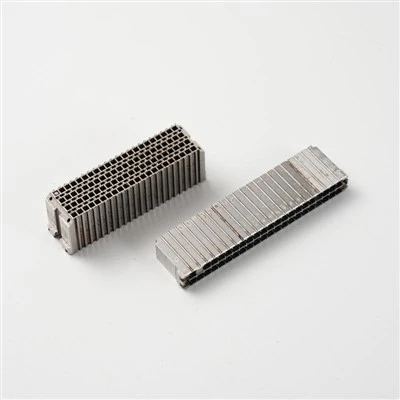
If you’re working on a project now, whether it’s a new car part, a medical device, a smartphone case, or a renewable energy component, don’t guess when it comes to stamping dies. We’ve helped hundreds of companies match the right die to their material, reducing scrap, increasing production, and cutting costs over time. Reach out, share your material specs and part requirements, and we’ll help you build a die that works for you, not against you.
Connector Mold References:
- Werkström, R. (2017). Fundamentals of Stamping Die Design. Industrial Press Inc.
- Kawai, N. (2020). Material Properties in Metal Stamping: A Practical Guide. Journal of Manufacturing Processes, Vol. 56, 1245-1258.
- Dieter, G. E. (2013). Mechanical Metallurgy (3rd ed.). McGraw-Hill Education.
- European Stamping Association. (2021). Best Practices for Die-Material Compatibility in High-Volume Stamping. ESA Technical Report Series.
Dongguan Hezong Precision Technology Co., Ltd.
With abundant experience, we are one of the most professional stamping die manufacturers and suppliers in China. Please feel free to buy durable stamping die made in China here from our factory. All customized products are with high quality and competitive price.
Address: No.973, Dalang Section of Wozhang Road, Dalang Town, Dongguan City, Guangdong Province
E-mail: postmaster@hezongjingmi.com
WebSite: https://www.hzpre.com/
